
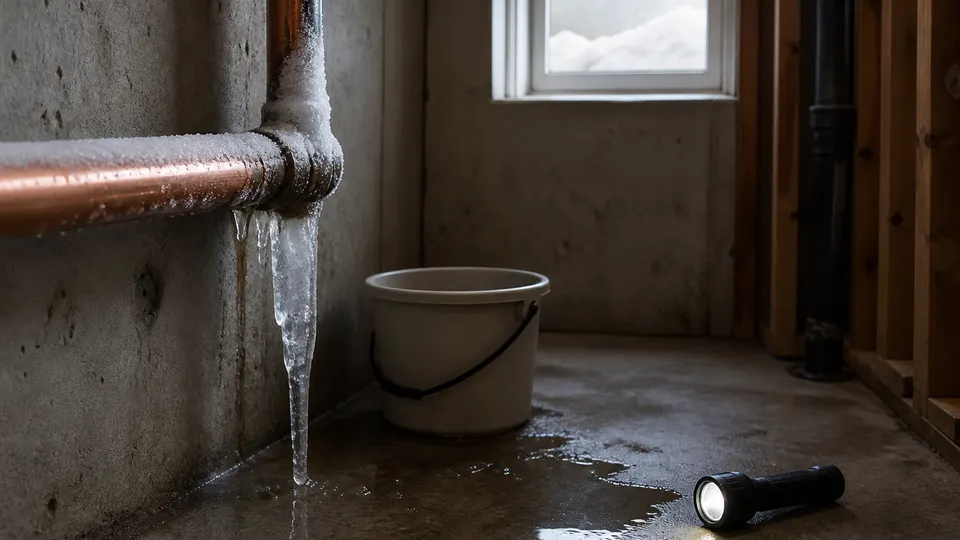
Water, not fire, is still the claim that empties Canadian basements every winter. The policy language that decides who pays is narrower than most declarations pages suggest.
A Winnipeg homeowner leaves for two weeks in January. The thermostat is set to 12°C. A supply line behind the laundry tub freezes on a −32°C night, thaws while the family is still away, and soaks the lower level. The insurer asks three questions that have nothing to do with how much the drywall costs: Was the heat maintained? Was the water shut off? When was the loss discovered?
Those questions are not trivia. They are the difference between a covered sudden-and-accidental escape of water and a denied freeze-up. This guide walks through the winter water claims Canadian adjusters actually see, how provinces differ, and what to document before the next cold snap.
The three winter water stories that get confused
Homeowners often say “the pipe burst” and assume one coverage path. Insurers split winter water into several perils with different endorsements and duties.
| What happened | Typical treatment | Watch-outs |
|---|---|---|
| Indoor pipe freeze and burst | Often covered if heat was maintained | Vacancy and “reasonable care” clauses |
| Ice dam leaking through the roof | May be covered as water from ice/snow | Poor attic insulation can become a maintenance argument |
| Sewer or sump backup | Usually optional endorsement | Not the same as a burst pipe; separate limit and deductible |
| Groundwater seeping through foundation | Usually excluded | Slow seepage is treated as maintenance, not a peril |
If your broker bundled “water damage” into one sentence at renewal, ask them to name which of those four you actually bought.
The heat-and-shut-off duty
Most Canadian homeowner forms require you to keep the dwelling heated to a stated temperature, or shut off the water and drain the system, when the home is unoccupied in freezing weather. The exact temperature is in the policy — commonly in the 12–15°C range — but the practical test is whether a reasonable person would have prevented freeze-up.
Smart thermostats help only if they were working and you can show the log. A neighbour who “checked the house” is useful if they can confirm heat was on; it is not useful if they never went inside. Insurers in Prairie cities see this dispute every March.
If you winterize a cottage, photograph the drained lines, the antifreeze in toilets, and the shut-off valve. Cottage claims fail more often on missing winterization proof than on the size of the loss.
Ice dams: weather versus upkeep
Ice dams form when attic heat melts roof snow, water refreezes at the eaves, and meltwater is forced under shingles. Many policies cover the resulting interior damage. They are less generous about the roof itself if the dam was caused by inadequate insulation or blocked ventilation that you were expected to fix.
After a claim, expect questions about attic hatches, bathroom fans dumping into the attic, and whether similar leaking happened in prior winters. A one-off ice storm is a different conversation from a house that dams every January.
Sewer backup is not “the pipe burst”
When a municipal main surcharges or a sump pump dies during a thaw, water comes up through drains. That is sewer backup or sump overflow — almost always an optional endorsement with its own limit, often $10,000 to $50,000 unless you bought more.
A burst supply line is a different peril. Mixing the two on a claim form slows the file. Photograph the point of entry: a split copper line versus water rising from a floor drain tells the story in one frame.
Provincial patterns
Ontario and Quebec: Freeze-ups in older urban housing, especially when tenants control the heat, generate disputes about who had the duty to maintain temperature. Quebec co-ownership adds a second policy — the syndicate’s — that may respond to building piping while your unit policy covers improvements.
Prairies: Polar-vortex stretches make “was the heat on” the first adjuster question. Alberta and Saskatchewan rural properties with crawlspaces and seasonal occupancy need explicit winterization records.
Atlantic Canada: Freeze-thaw cycles and older galvanized or mixed piping produce both burst-pipe and ice-dam claims in the same week. Coastal wind-driven rain is a separate water story; do not file it as a freeze-up.
British Columbia: Coastal winters are wet more than arctic, but interior BC still sees freeze claims in valleys. Sewer backup during atmospheric-river events is the larger dollar story — and it is still an endorsement, not automatic.
What to do in the first 48 hours
- Stop further damage: shut the water, run safe heat, pull soaked contents away from walls.
- Photograph every room before contractors tear out drywall.
- Keep receipts for a plumber, wet-vac rental, and dehumidifier — mitigation is usually recoverable on a covered loss.
- Call the insurer or broker promptly. Late notice is a favourite coverage defence when mould has had two weeks to grow.
- Do not throw out damaged contents until the adjuster has seen them or given written permission.
A Calgary example
A 1990s split-level in the northeast had a $1,000 all-perils deductible and no sewer-backup endorsement. In February a supply line burst in a bathroom wall — covered, minus the deductible. Two weeks later a thaw overwhelmed the neighbourhood sewer and two feet of water entered through the floor drain. That second event was denied. The family had assumed “we already had a water claim, so water is covered.” It was not.
The cheaper fix at the prior renewal would have been a $25,000 sewer endorsement. The more expensive lesson was learning the difference after the fact.
Prevention that still matters at claim time
- Keep indoor taps dripping on the coldest nights in poorly insulated rooms.
- Open cabinet doors under kitchen and bathroom sinks on exterior walls.
- Know where the main shut-off is — and that everyone in the house knows too.
- Replace washing-machine hoses on a schedule; they fail on holiday weekends.
- If you travel, have someone physically confirm heat twice a week, not only via an app.
Questions for your broker before November
Ask, in writing: Is freeze-up covered if we are away more than 72 hours? What temperature must we maintain? Is sewer backup included, at what limit, and is it combined with overland flood? Is there a separate water deductible? If the roof is over 15 years old, is ice-dam damage still replacement cost?
Winter water claims are not mysterious. They are documentary. The households that collect are the ones that can show heat, notice, photos, and the right endorsement — not the ones who had the most dramatic basement.