
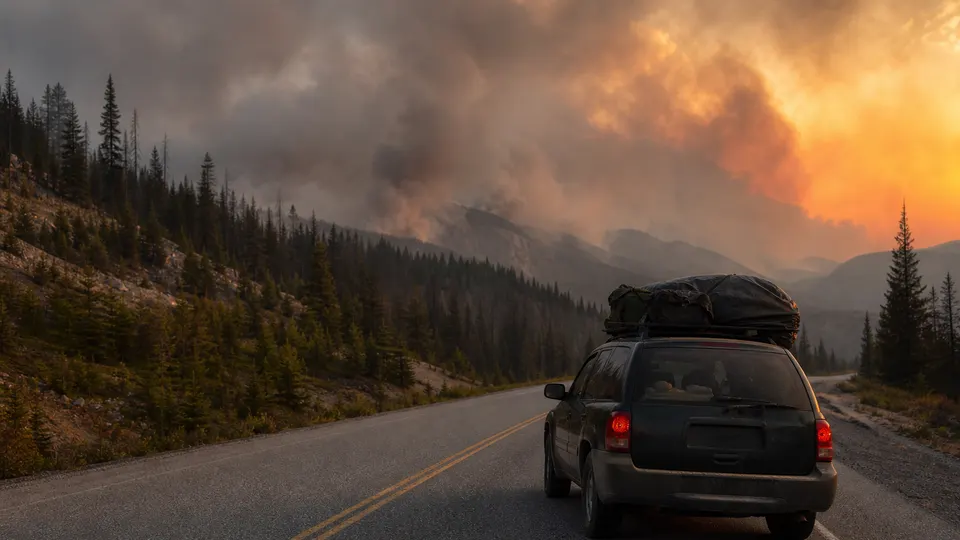
Evacuation coverage is not a hotel coupon. It is a policy section with limits, triggers, and a paper trail that starts the day you leave.
In recent fire seasons, families from Kelowna, Yellowknife, Jasper, and communities across the Interior have learned that “additional living expense” (ALE) — sometimes called additional living costs or loss of use — is the coverage that pays for a motel, meals above normal, and a rental if you cannot go home. They have also learned that it does not automatically pay for every restaurant receipt or a two-week stay in a resort because it was available.
This article is for homeowners and renters who live in wildfire-exposed parts of Canada and want the ALE conversation finished before smoke is on the horizon.
What ALE is designed to do
ALE puts you back, as reasonably as possible, in the living standard you had before the loss. If your home is uninhabitable because of a covered peril, or a civil authority bars access, the insurer may pay extra costs you would not otherwise have incurred.
The key words are extra and necessary. Your usual grocery bill is not extra. The difference between cooking at home and buying meals because you have no kitchen can be. A pet-friendly motel because you cannot leave the dog in an evacuation zone is often easier to justify than a suite upgrade “because it was the only room left” without notes from the front desk.
The civil-authority trigger
Many Canadian policies include a civil-authority clause: if a public authority prohibits access because of a neighbouring covered peril — a wildfire that has not yet reached your lot — ALE can still respond for a limited time, often 14 to 30 days, even if your house is untouched.
That clause is why you keep the evacuation order. A social-media rumour is not an order. A municipal or provincial alert, a screenshot of the official map, and the date you left are the file.
If you leave “just in case” before an order, coverage is less certain. Some insurers still consider imminent danger; others want the official trigger. Ask your broker how your form is worded, in writing, before fire season.
Limits people underestimate
| Item | How it usually works | Practical tip |
|---|---|---|
| ALE dollar limit | Often a percentage of dwelling coverage, or a stated cap | Long rebuilds exhaust it; ask about increasing it |
| Time limit on civil authority | Days, not months | If the order lasts longer, confirm in writing |
| Pets | Boarding may be extra living cost | Keep kennel invoices separate |
| Deposits | May be reimbursable if reasonable | Avoid prepaid luxury stays you cannot cancel |
What to pack for the claim, not just the car
- Policy number and broker after-hours line in your phone, not only on a paper in the house.
- Photos of the home as you leave — not for social media, for condition.
- A folder (cloud) with ID, medication lists, and pet vaccination records.
- A simple expense log: date, merchant, amount, why it was extra.
Credit-card statements alone are a weak file. A $180 dinner needs a one-line note: “no cooking facilities, family of four.” Adjusters are not trying to audit your taste; they are trying to separate extra costs from ordinary life.
BC, Alberta, and the North
British Columbia’s interface communities — houses against forest — face both property damage and repeated short evacuations. ALE can trigger more than once in a season. Confirm whether multiple civil-authority events reset the clock or share one limit.
Alberta’s 2023 and 2024 seasons showed that rental markets in receiving cities tighten overnight. “Reasonable” accommodation may be whatever was available that night. Document sold-out cheaper options with screenshots.
Territorial and remote evacuations add airfare, longer hotel stays, and sometimes separate government assistance. Insurer ALE and public emergency payments can interact. Tell the adjuster about any government support so the file does not later look like a double recovery you hid.
Renters are not automatically covered by the landlord
The building policy may repair the structure. Your tenant policy, if you have one, is what typically carries ALE for your hotel and contents. Students and seasonal workers in fire-exposed towns are often uninsured for this exact reason.
A Kelowna composite
A family evacuated under a civil-authority order for 11 days. The house was never damaged. They stayed in a chain hotel, ate out, and boarded a cat. ALE paid the hotel, the cat boarding, and a meal differential the adjuster calculated from a reasonable per-diem minus a typical grocery baseline. It did not pay a lakeside villa they booked on night three “to be more comfortable,” because cheaper rooms had opened in town. The order printout and a daily expense sheet closed the file in three weeks. Neighbours who submitted a shoebox of receipts without dates waited until winter.
After you are allowed home
ALE can continue if smoke, ash, or utility shutoff still makes the house uninhabitable — that is a different trigger than civil authority. Get the “you may return” notice and, if the house is not livable, a note from the fire authority, contractor, or public health about why. Smoke remediation is its own claim conversation; do not assume ALE runs until every curtain is replaced.
Questions to ask this spring
What is my ALE limit in dollars? How many days does civil authority cover? Does the policy require an official evacuation order? Are pet boarding and additional mileage included? If I stay with family, can I still claim extra meal and laundry costs?
Wildfire seasons now last longer than the paragraph in last year’s policy booklet. Read the ALE section while the sky is still blue.