
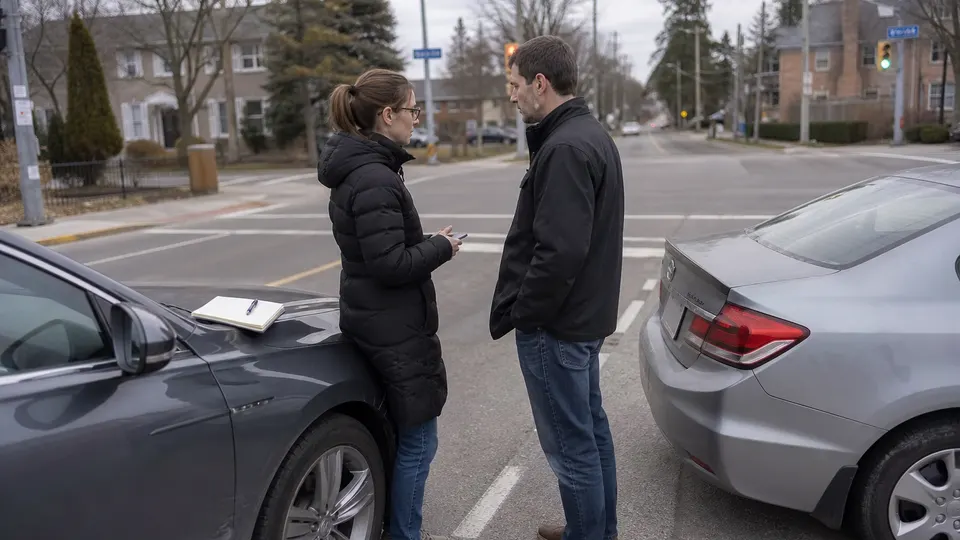
In Ontario, many collision outcomes are decided by regulation diagrams, not by whose dash-cam rant is more convincing.
The Fault Determination Rules (FDR) under the Insurance Act assign fault percentages for common crash patterns so that Direct Compensation – Property Damage (DCPD) and your driving record can be administered without waiting for a courtroom. You can still disagree. You should still photograph the scene. You should not expect a polite story to override a diagram that says you were reversing from a driveway.
What DCPD is
For many Ontario collisions with another Ontario-insured vehicle, you claim vehicle damage from your own insurer under DCPD, and fault rules decide how much of your deductible applies and how the accident sits on your record. It feels backwards if you grew up in a province where you claimed against the other driver first. It is the system you are in.
Common diagrams people argue with
- Rear-end: the following driver is usually at fault.
- Left turn across oncoming traffic: the turning driver is usually at fault.
- Lane change: the driver entering the occupied lane.
- Parking lots: often a different, messier analysis; still document everything.
Weather is not a free pass. “I slid” is still a following-too-close conversation in many rear-end files.
When the rules do not finish the story
Hit-and-run, unidentified drivers, single-vehicle losses, out-of-province vehicles, and some injury claims follow other paths (uninsured automobile, tort, accident benefits). FDR is not the whole Insurance Act. If someone is injured, accident benefits are a separate, urgent conversation — apply on time.
Evidence that still matters
Photos of rest positions, damage, lights, road markings, and weather. Witness names. The other driver’s insurance particulars. A police report when required or when there is injury. Dash-cam footage that is time-stamped. None of this “beats” a rule that clearly applies; all of it helps when the pattern is not in the cartoon, or when you are asking for a review.
A Mississauga example
Two drivers described a four-way-stop mix-up. One had a dash-cam; the other had certainty. The insurer applied the relevant FDR pattern and a 50/50 split that neither liked. A request for review with the video moved the file to a different percentage. The video did not “win the internet.” It identified which diagram actually matched.
After the call
- Ask which FDR section was applied.
- Read your policy on deductible and how at-fault accidents affect renewals.
- If you disagree, use the insurer’s dispute process with evidence, then the ombuds path if needed.
Ontario fault rules are bureaucratic on purpose. They trade some individual storytelling for speed. Bring photos anyway. Bureaucracy still has to pick a diagram, and diagrams are easier to pick when the intersection is on camera.